
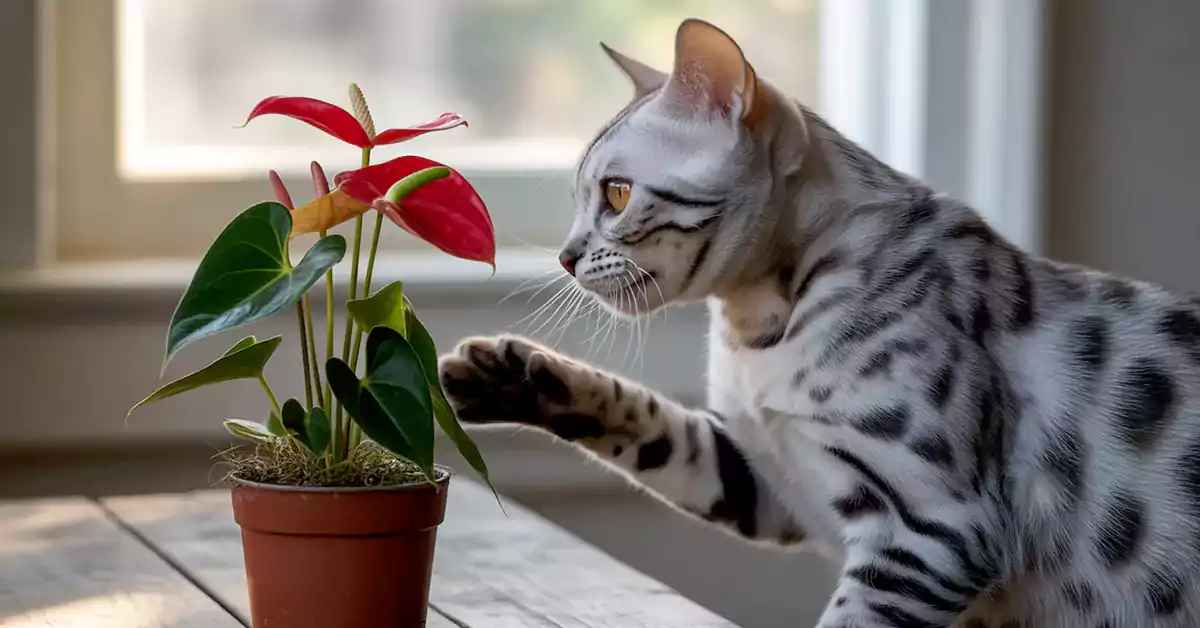
If you love beautiful houseplants and you’re a cat parent, you might be wondering:
Are anthuriums toxic to cats?
The short answer is YES — anthuriums are toxic to cats.
But don’t panic. Most cases cause irritation and discomfort, not long-term harm, especially if treated quickly.
This guide explains exactly why anthuriums are toxic, what symptoms to look for, what to do if your cat chews the plant, and how you can safely keep anthuriums at home.
Read More: Why Does My Cat Sit on My Laptop or Keyboard? (Here’s the Real Reason!)
Why Are Anthuriums Toxic to Cats?
Anthuriums (also known as Flamingo Flower or Laceleaf) contain insoluble calcium oxalate crystals.
These crystals act like tiny needles.
When your cat bites the leaf or stem:
- The crystals get lodged in their mouth and throat
- They cause sudden irritation
- Pain triggers drooling and pawing
- In some cases, vomiting or swelling
It’s basically like your cat chewing something extremely spicy + sharp at the same time (ouch!).
The good news?
These irritations are painful but rarely dangerous when you act fast.
Symptoms of Anthurium Poisoning in Cats (Explained in Detail)
Symptoms usually begin within minutes after chewing the plant.
Below is an expanded explanation of each symptom to help you understand what’s normal and what’s serious.
Common Symptoms (Most Cats Experience These)
1. Drooling (Hypersalivation)
This is the most immediate sign.
The oxalate crystals burn your cat’s mouth and gums, triggering excessive drooling.
Cats may shake their head, flick drool everywhere, or spit foam.
2. Pawing at the mouth
Because the crystals are painful, cats instinctively try to remove the discomfort by pawing their mouth repeatedly.
If you notice constant rubbing or scratching, assume the plant was chewed.
3. Red or swollen gums
The gums, tongue, and inner lips may appear red, irritated, or slightly swollen.
This swelling usually happens within 5–15 minutes of chewing the plant.
4. Difficulty swallowing
Your cat may gulp repeatedly, swallow hard, or refuse to swallow food or water.
This happens because the tongue and throat feel irritated and raw.
5. Excessive meowing or vocal discomfort
Cats might cry, meow constantly, or show restlessness.
This is their way of expressing pain or confusion.
6. Vomiting
Some cats vomit if they swallow small pieces of the plant. This helps the body remove toxins.
7. Refusing food
Due to oral discomfort, they may temporarily avoid food or water. This usually resolves within a few hours after treatment.
8. Rubbing face on surfaces
Your cat may rub their mouth against furniture or the floor to relieve the burning sensation.
More Serious (but Rare) Symptoms
Seek vet help immediately if you see any of these:
1. Difficulty breathing
Severe throat swelling can make breathing harder.
This is uncommon but requires urgent care.
2. Severe swelling of the tongue or throat
If the swelling spreads deeper, your cat may panic or gasp.
These cases need a vet fast.
3. Lethargy
If your cat becomes weak, slow, or unusually quiet, it could indicate deeper irritation or dehydration.
4. Signs of pain
Hunched posture, hiding, growling, or avoiding touch may indicate more severe discomfort.
While these rare symptoms sound scary, they are uncommon and usually happen only if a cat ate a large amount of the plant.
What To Do If Your Cat Ate an Anthurium (Step-by-Step Guide)
Here’s exactly what to do to protect your cat:
1. Stay calm and check their mouth
Panicking will stress your cat and make symptoms worse.
Try to see if pieces of the plant are still in the mouth.
2. Rinse the mouth gently
Use:
- Cool water
- A wet cloth
- A syringe (no needle)
Rinse for 30–60 seconds to wash away the crystals.
3. Give a soothing food
Offer a small amount of:
- Milk
- Plain yogurt
- Tuna water
- Chicken broth
These coat the mouth and reduce irritation.
4. Monitor your cat for 1–2 hours
Most cats improve noticeably within an hour.
5. Call your veterinarian
Even if symptoms are mild, a quick vet call ensures there’s no risk of complications.
Do NOT
- Do NOT induce vomiting
- Do NOT give human medicines
- Do NOT force-feed water
- Do NOT wait if breathing is affected
Prompt care = quick recovery.
Are All Parts of an Anthurium Toxic?
Yes — every part contains oxalate crystals:
- Leaves
- Stems
- Roots
- Flowers
- Sap
- Even water collected in the pot tray
So even a small nibble can cause symptoms.
Can You Keep Anthuriums at Home if You Have Cats?
Yes — you do NOT need to throw your plant away.
Just keep it safely out of reach.
Best Safety Methods
- Use high shelves with no jump routes
- Switch to wall-mounted or hanging planters
- Keep anthuriums in closed rooms
- Use citrus sprays cats dislike
- Offer cat-friendly plants (cat grass, catnip)
- Place double-sided tape near plant tables
- Use plant cabinets with glass doors
These simple tricks let you keep your home stylish and your cat safe.
Cat-Safe Alternatives to Anthuriums
Try these safe and beautiful houseplants:
- African Violet
- Bromeliads
- Calathea varieties
- Spider Plant
- Orchids
- Parlor Palm
- Areca Palm
These add colour without risking your cat’s health.
Frequently Asked Questions
Yes. Anthuriums contain insoluble calcium oxalate crystals that irritate a cat’s mouth and digestive system.
Your cat may drool, paw at the mouth, vomit, or show swelling. Most recover quickly with treatment.
Very unlikely. It causes discomfort, not usually life-threatening toxicity.
No. It’s toxic to cats, dogs, and even small animals.
No. It’s toxic to cats, dogs, and even small animals.
Avoid: peace lily, pothos, philodendron, dieffenbachia, monstera, and aloe vera.